
Published
The dependency nobody questions anymore
The morning shift needs a saved report view showing orders approaching the carrier cutoff. The data is already in the WMS; the supervisor only needs an approved filter and column arrangement. But the view is locked behind an administrator account. A ticket goes to IT, the specialist is handling an interface incident, and the request waits until Thursday. Meanwhile, the team exports the report and sorts it manually each day.
Dependency often grows one reasonable restriction at a time. Selecting a predefined label format, assigning an approved user role, or adjusting a parameter within agreed limits becomes another ticket. Eventually, asking IT is the default response before anyone considers whether the change actually requires technical expertise.
The hidden cost of putting everything in an IT queue
A small request can carry a larger operational consequence. Supervisors delay decisions, improvements lose momentum, and teams develop extra steps while waiting. When only one or two specialists understand the configuration, their availability becomes a constraint on everyday warehouse work. Holidays, competing projects, and incidents expose how much knowledge sits with too few people.
IT pays a price as well. Repeated requests interrupt reliability work, integration improvements, and security responsibilities. Urgency on the floor does not automatically make a minor configuration request more critical than a system incident. The resulting frustration is often blamed on IT responsiveness, although the underlying problem lies in responsibilities, permissions, documentation, and operating procedures. A faster ticket queue alone will not resolve that design problem.
Not every WMS change requires a developer
Routine configuration uses supported settings to select behavior the system already provides. Technical customization changes or extends that behavior through code, interfaces, or specialized modifications. The distinction matters, but a configuration screen is not proof that a change is low risk. A setting can influence inventory allocation, replenishment, billing, or the next system in a shipment flow.
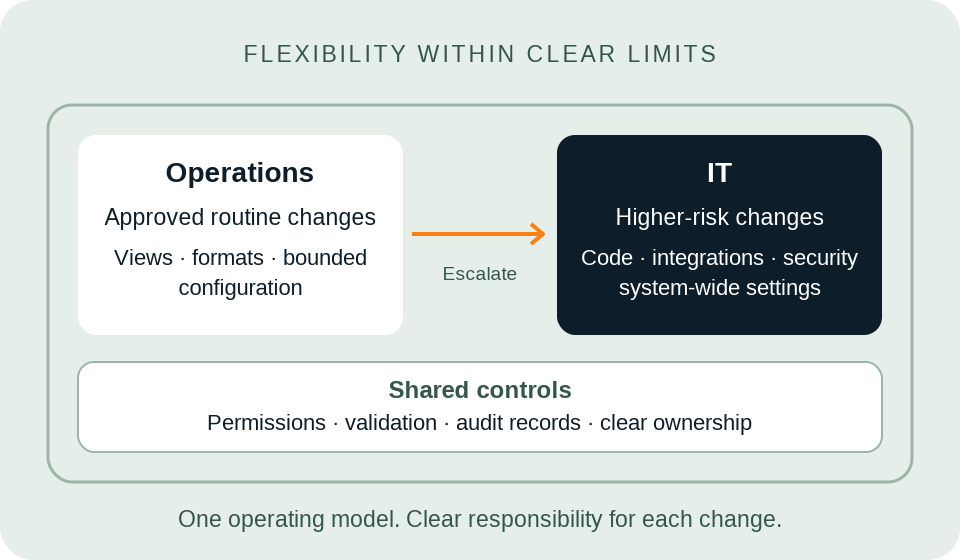
Potential candidates for delegation include personal report views, selecting from validated label formats, or maintaining a documented process setting within a narrow range. Approved role assignments may also be delegated where access governance permits, with authorization and separation of duties; nobody should approve their own elevated access. Changing a label template or barcode content is a different decision from selecting an already approved format.
The boundary depends on the WMS product, version, configuration, security requirements, and downstream impact. Blue Yonder, Manhattan, and other platforms do not offer identical controls. Confirm what your environment supports and assess the actual change before deciding who can perform it.
What should remain under IT ownership
Custom code, integrations, security-sensitive changes, core business logic, and system-wide settings generally need specialized technical ownership and formal change management. Changes affecting several processes require impact analysis even when they involve configuration alone. Adjusting an allocation rule, for example, may alter which orders receive inventory and how replenishment responds.
IT should own technical implementation and deployment controls, while operations owns the business requirements and helps validate the result. Where consequences cross teams, governance should be joint. Testing, recovery planning, approval records, and traceability protect stability and security. Clear boundaries give both groups a dependable way to collaborate when a request exceeds the routine catalog.
The solution: controlled operational autonomy
Start with the most common IT tickets. Group them by the requested action, operational purpose, frequency, and potential consequence. Separate requests needing technical investigation from repeated, understood tasks. Operations and IT can then select a small pilot group whose permissions and effects are well understood.
For each approved task, document who owns it, who may execute it, the permitted scope, and the validation required. Define exact limits: a particular site, a validated label list, or an agreed parameter range. Use role-based permissions that enforce those limits wherever the platform supports them. If permissions cannot isolate the action safely, retain technical execution rather than relying only on written instructions.
Train named operational users and provide a short procedure with examples, stop conditions, and escalation contacts. Validation should match the risk: checking a personal report view may be straightforward, while a shared configuration can require non-production testing and downstream checks. Record who changed what, when, and why through system audit trails or an approved change record.
Review the pilot across shifts. Check turnaround time, errors, reversals, and whether another team inherited extra work. Review permissions periodically and when responsibilities change. Expand only when the evidence supports it. The objective is a better operating model, not transferring a backlog to supervisors who lack time, training, or support.
Free your IT experts to focus on what matters
Controlled autonomy lets operations respond sooner to approved, low-risk needs. IT gains room for WMS stability, complex integrations, security and access management, automation, architecture, and problems that require specialist knowledge. Documented procedures also make routine work less dependent on the availability of a particular individual.
Use with your team
Working checklist
Checks are temporary and are not saved or submitted. Use Print / save PDF for your working copy.
Educational guidance. Apply it to your product, version, operating conditions, and agreed controls; it is not a project-specific solution design.
A well-governed WMS should support operational flexibility while preserving technical control. That balance comes from deliberate permissions, clear ownership, and collaboration. Which requests in your IT queue could safely be resolved closer to warehouse operations—and what controls would make that possible?