System interfaces
Map ERP, WMS, transport, customer, and automation transactions. Define identifiers, acknowledgments, retries, sequencing, and reconciliation alongside the business payload.
 QALogistics
How we help
Stop carrying the gaps between systems by hand.

The operational view
When orders disappear between applications, labels need constant correction, or operators depend on spreadsheets to finish the work, your team absorbs the cost. We help connect the transaction and address the underlying gap, with integrations and extensions that are understandable, testable, and supportable.
Where we help
Map ERP, WMS, transport, customer, and automation transactions. Define identifiers, acknowledgments, retries, sequencing, and reconciliation alongside the business payload.
Develop and refine scanning, validation, exception handling, and task execution flows. Check usability with realistic devices and representative work rather than desktop demonstrations alone.
Support customer labels, operational reporting, scheduled jobs, MOCA logic, and PageBuilder extensions where appropriate to the installed product and version.
Keep changes traceable in source control. Build repeatable deployment steps, representative test data, and a documented recovery path before release.
What changes
Scope, deliverables, and measures are agreed for each engagement.
How we deliver
Listen to what is hurting, understand the pressure on your team, and agree what better should look like.
Address the causes across process, systems, and data with a solution your people can actually use.
Check the everyday work and difficult exceptions together, so confidence comes from evidence.
Stabilize the improvement, equip your team, and extend what works as your needs grow.
A useful next read

Articles & field notes 01
July 9, 2023
What a dependable ERP-to-WMS interface contract should explain.
Explore
Articles & field notes 02
July 23, 2025
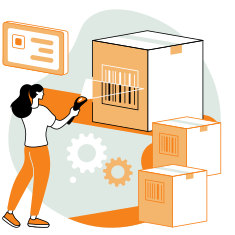
Control labels through data, templates, printers, and downstream scanning.
Explore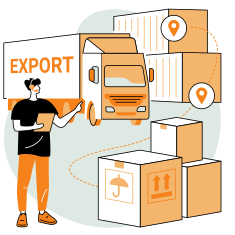
Articles & field notes 03
August 14, 2025
Keep packing, manifesting, loading, and dispatch from becoming conflicting promises.
ExploreCommon questions
Yes. We first map dependencies and assess the existing code, deployment process, and support history. Retain, refactor, or retire decisions should reflect business value and maintainability.
Yes. The appropriate mechanism depends on the systems involved. Mapping, acknowledgment, reconciliation, and operational recovery matter regardless of transport.
You don’t have to solve it alone
The recurring issue. The difficult rollout. The system nobody trusts. Start wherever you are—we’re here to help you find a way forward.
Start with the operation
Choose the area closest to the work in front of you. We’ll ask for the details next.
Your conversation
Inquiry sent
Your inquiry is on its way to QA Logistics. We’ll be in touch soon.