
Insights
Articles & field notes
Perspectives that connect warehouse decisions to system behavior.
57 resources, grouped by topic
Strategy & selection

Articles & field notes 01
February 1, 2023
What is a WMS—and what should it change on the floor?
Understand warehouse management through the decisions it supports, not a feature checklist.
Explore

Articles & field notes 02
February 23, 2023
WMS vs ERP: where should each decision live?
A practical way to define boundaries and decide whether an additional WMS is necessary.
Explore
Articles & field notes 03
November 21, 2023
What a 3PL should ask of its WMS operating model
Balance repeatable onboarding with controlled customer-specific requirements.
Explore
Articles & field notes 04
January 5, 2024
Inventory software or WMS: choose the control you actually need
Distinguish knowing the stock balance from directing the work that changes it.
Explore
Articles & field notes 05
January 28, 2024
When does a warehouse need a WMS? Look for complexity, not a size threshold
Use operating signals to decide when stronger warehouse execution control is justified.
Explore
Articles & field notes 06
February 19, 2024
WMS benefits: distinguish better control from a promised percentage
Build a benefit case that operations and finance can test after implementation.
Explore
Articles & field notes 07
March 13, 2024
The WMS costs that appear after the implementation budget
Plan for ownership, change, and reliability—not only software and initial configuration.
ExploreImplementation & change

Articles & field notes 01
November 1, 2026
When a Small WMS Change Creates a Bigger Warehouse Problem
A WMS change can pass its individual test and still disrupt connected work. Map dependencies, test realistic exceptions, and assess operational risk before release.
Explore
Articles & field notes 02
October 9, 2026
Your WMS Is Live. But Is Your Implementation Really Successful?
Go-live proves the warehouse can start. The months that follow reveal whether the system can support the operation, absorb change, and deliver lasting value.
Explore
Articles & field notes 03
May 24, 2023
Why WMS programs lose control—and how to spot it early
Warning signs in requirements, data, testing, and operational ownership.
Explore
Articles & field notes 04
April 4, 2024
WMS discovery starts on the floor, not in the requirements template
Turn observed warehouse behavior into requirements people can validate.
Explore
Articles & field notes 05
April 27, 2024
WMS data migration: prove the data through transactions
A loaded record count is not evidence that the warehouse is ready to operate.
Explore
Articles & field notes 06
May 20, 2024
Warehouse UAT: give operations evidence, not a pass-rate target
Make user acceptance testing an operational decision rather than a checkbox phase.
Explore
Articles & field notes 07
June 11, 2024
WMS adoption: prepare people for exceptions, not just screens
Build role-specific operating confidence before the first production shift.
Explore
Articles & field notes 08
July 26, 2024
Multi-site WMS rollout: standardize the decision, not every local detail
Use a common core while making genuine facility differences explicit.
ExploreIntegration & extensions

Articles & field notes 01
July 9, 2023
WMS integration: design the recovery path with the happy path
What a dependable ERP-to-WMS interface contract should explain.
Explore
Articles & field notes 02
October 21, 2025
Your interfaces can be green while the warehouse is stuck
Monitor business completion, not only whether applications can connect.
Explore
Articles & field notes 03
November 12, 2025
Before you replay the message, find out what already happened
Avoid turning an uncertain interface result into a duplicate business event.
Explore
Articles & field notes 04
December 5, 2025
Who owns the item master when three systems can change it?
Prevent local corrections from becoming an endless cross-system disagreement.
Explore
Articles & field notes 05
December 28, 2025
RF workflow design must survive the interrupted scan
Keep physical work and recorded state aligned when devices or connectivity fail.
Explore
Articles & field notes 06
June 4, 2026
Extend the WMS or change its core? Start with the gap
Choose a proportionate solution for a focused operational need.
ExploreInventory & inbound

Articles & field notes 01
August 23, 2023
Inventory integrity is a chain of decisions
Why counting alone cannot fix persistent inventory differences.
Explore
Articles & field notes 02
August 18, 2024
Warehouse data quality: find the fields that change the work
Prioritize data corrections by operational consequence rather than spreadsheet completeness.
Explore
Articles & field notes 03
September 9, 2024
Receiving accuracy begins before the truck reaches the dock
Connect supplier expectations, physical verification, and usable inventory.
Explore
Articles & field notes 04
October 2, 2024
Dock-to-stock time: measure the delay you actually want to remove
Define the beginning and end before using the metric to judge performance.
Explore
Articles & field notes 05
October 25, 2024
Putaway overrides are feedback about your design
Use repeated operator exceptions to improve location rules and data.
Explore
Articles & field notes 06
November 16, 2024
Present, available, allocatable: three different inventory questions
Explain why stock can exist while an order still cannot use it.
Explore
Articles & field notes 07
December 9, 2024
Cycle counts should reduce uncertainty—not repeatedly erase it
Connect discrepancies to transaction causes instead of stopping at the adjustment.
Explore
Articles & field notes 08
December 31, 2024
FEFO is not the whole shelf-life policy
Connect expiration sequencing with customer eligibility, data, and exception authority.
Explore
Articles & field notes 09
January 23, 2025
Can your warehouse answer a traceability question without a spreadsheet rescue?
Test the relationships between receipts, transformations, locations, and shipments.
Explore
Articles & field notes 10
June 7, 2025
Item dimensions: small data errors with a long operational reach
Follow dimension and pack errors through storage, replenishment, packing, and transport.
ExploreSupport & reliability

Articles & field notes 01
November 13, 2026
Why the Same WMS Problems Keep Coming Back
A restored warehouse workflow and a prevented recurrence are different outcomes. Separate urgent recovery from tracked corrective work, then validate and monitor changes under relevant operating conditions.
Explore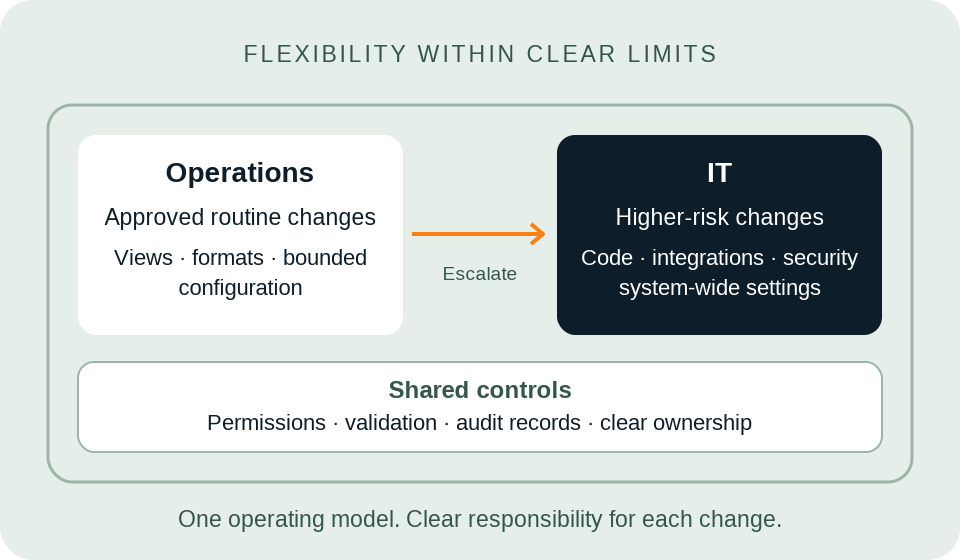
Articles & field notes 02
October 23, 2026
When Your Warehouse Depends Too Much on IT
Routine WMS requests can slow warehouse decisions. Learn how operations and IT can define safe configuration boundaries and controlled operational autonomy.
Explore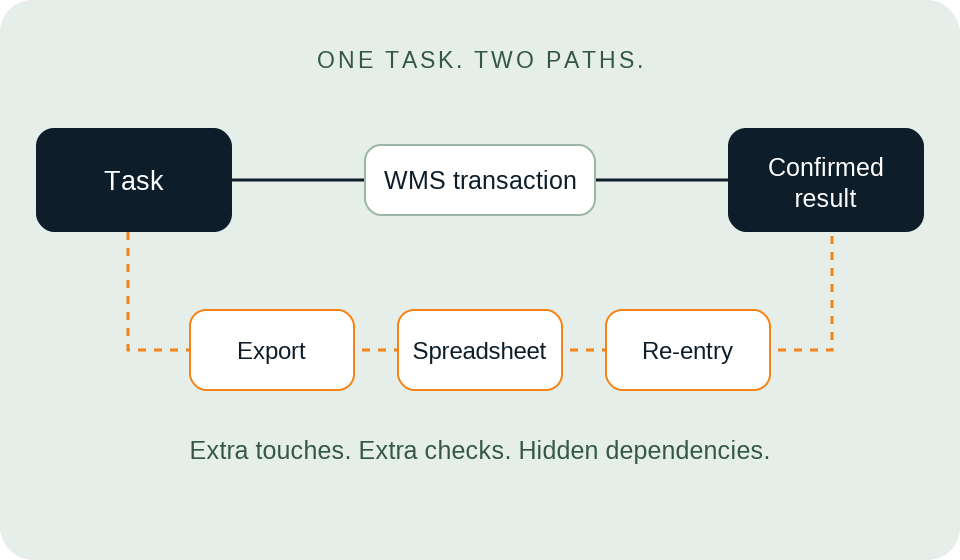
Articles & field notes 03
October 16, 2026
The Hidden Cost of WMS Workarounds
The extra spreadsheet, repeated correction, and unofficial handoff keep the shift moving. What happens when the operation starts depending on them?
Explore
Articles & field notes 04
September 14, 2023
From incident queue to warehouse stability
Build a support model around impact, evidence, and repeatable recovery.
Explore
Articles & field notes 05
July 4, 2024
When is WMS hypercare really finished?
Use stable operation and transferred ownership as the exit criteria.
Explore
Articles & field notes 06
February 11, 2026
A slow WMS needs a workload diagnosis, not a random database tweak
Connect technical observations to the warehouse activity people are struggling to complete.
Explore
Articles & field notes 07
March 5, 2026
A backup is not a recovery plan
Prove that the warehouse can resume—not merely that a database can be restored.
Explore
Articles & field notes 08
March 28, 2026
What should a WMS support agreement make clear?
Remove uncertainty about ownership before the difficult shift arrives.
ExploreAutomation & intelligence

Articles & field notes 01
October 29, 2023
WMS, WCS, and WES: agree the boundaries before connecting them
Avoid competing decisions and ambiguous recovery in automated warehouse flows.
Explore
Articles & field notes 02
January 19, 2026
After automation stops, recovery is an inventory problem too
Coordinate physical recovery, control-system state, and WMS records.
Explore
Articles & field notes 03
June 26, 2026
Useful warehouse AI begins with a boundary
Choose decision support that reduces uncertainty without quietly taking control of execution.
ExploreReporting & people

Articles & field notes 01
November 6, 2026
When Your WMS Dashboard Doesn't Tell the Whole Story
A warehouse dashboard can accurately report what it measures and still miss the context needed to act. Review its definitions, freshness, exceptions, and ownership before adding another metric.
ExploreArticles & field notes 02
December 14, 2023
Warehouse KPIs: agree the definition before building the dashboard
Connect measures to decisions, ownership, and the underlying WMS events.
Explore
Articles & field notes 03
April 19, 2026
Before comparing warehouse KPIs, compare their definitions
Avoid misleading conclusions from measures that share a name but not a calculation.
Explore
Articles & field notes 04
May 12, 2026
Labor insights need context before conclusions
Use operational data to understand obstacles and support people—not oversimplify their work.
ExploreOutbound & flow

Articles & field notes 01
November 20, 2026
Why Faster Picking Starts Before the First Pick
Picking rate is shaped before a picker starts: usable stock, suitable locations, and executable work all matter. Observe waiting, travel, and rework alongside active picks, then improve the constraint without sacrificing order accuracy or downstream readiness.
Explore
Articles & field notes 02
February 15, 2025
Choose a picking method around the order profile—not the trend
Compare discrete, batch, cluster, and zone methods through the whole fulfillment path.
Explore
Articles & field notes 03
March 9, 2025
More released work does not always mean more shipped orders
Control work in progress around the capacity of the entire operation.
Explore
Articles & field notes 04
April 1, 2025
The short pick is a symptom. Follow it to the source.
Reduce recurring shortages by distinguishing inventory, replenishment, and execution causes.
Explore
Articles & field notes 05
April 23, 2025
Why replenishment is always urgent—and how to change the pattern
Investigate timing, capacity, and parameters before adding another emergency queue.
Explore
Articles & field notes 06
May 16, 2025
Good slotting balances picking travel with replenishment reality
Evaluate placement recommendations as an operational plan, not an item ranking.
Explore
Articles & field notes 07
June 30, 2025
Packing controls that catch the right errors without adding noise
Design verification around failure modes rather than accumulating scans.
Explore
Articles & field notes 08
July 23, 2025
A label change is a production change
Control labels through data, templates, printers, and downstream scanning.
Explore
Articles & field notes 09
August 14, 2025
When is an order actually shipped? Agree the event before the interface
Keep packing, manifesting, loading, and dispatch from becoming conflicting promises.
Explore
Articles & field notes 10
September 6, 2025
Returns are not receiving in reverse
Design the decisions between a returned parcel and usable inventory.
Explore
Articles & field notes 11
September 28, 2025
A warehouse can finish on time and still miss the truck
Coordinate internal readiness with the carrier handoff the promise depends on.
ExploreLooking for a concept explained from the beginning? Explore our 100-topic learning library.
You don’t have to solve it alone
Tell us what is making the work harder.
The recurring issue. The difficult rollout. The system nobody trusts. Start wherever you are—we’re here to help you find a way forward.